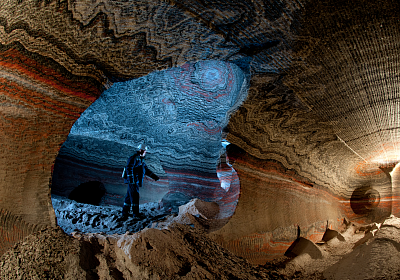
A petrified tree dating back around 250 mln years, which was earlier found in Uralkali’s Berezniki-4 mine, has been delivered to the laboratory of the Mining Institute of the Ural Department of the Russian Academy of Sciences. The fossilised remains will be analysed to determine its species and occurrence conditions, and to learn more how the Verkhnekamskoye deposit of potassium and magnesium salts had been formed. The Mining Institute intends to run a whole range of investigations including mineralogical, lithological, paleobotanical and geochemical tests.
The tree was originally spotted by a mining machine operator on a tunnel wall some 400 metres below the surface. A piece of the surrounding rock was cut out from the wall and then sliced into several plates. The plates were shared with the Mining Institute, VNII Galurgii, the Perm State National Research University, and Uralkali’s corporate museum.
Sergey Glebov, Uralkali Chief Geologist:
It is the fifth discovery of fossilised flora of the Permian period in an Uralkali’s mine since the development of the Verknekamskoye deposit began almost 90 years ago. Paleontological remains are very rare here, but those that are discovered are in a very good condition thanks to the preservative effect of salts of the ancient Permian Sea. What makes this latest find unique is not only the beautiful cross-section pattern of wood – which would not offend even the finest museum collections – but also its internal structure that shows how sylvite and halite from the salt water gradually precipitated inside the cracks that formed during carbonisation of the tree.
Ilya Chaikovsky, Head of Mineral Deposit Geology Laboratory of the Mining Institute:
The carbonised wood discovered in a mine can be preliminary dated back to the Early Permian. Modern research methods will help us discover the role of plant remains in the creation of gas clusters during the formation of the Verkhnekamskoye deposit of potassium and magnesium salts. This information will be important for future mining of potash layers. The structure of the wood will also give us a better understanding of vegetation growing near an ancient sea and of the temperature conditions of the salt field during the historical subsidence and folding of the Verkhnekamskoye deposit./p>
Uralkali (www.uralkali.com) is one of the world’s largest potash producers and exporters. The Company’s assets consist of 5 mines and 7 ore treatment plants in the towns of Berezniki and Solikamsk (Perm Region, Russia). Uralkali employs more than 13,300 people in the main production unit.